Hammer Drill vs. Impact Driver : Which Tool Do You Actually Need
You are standing in the hardware store aisle, staring at a wall of yellow, red, or teal boxes. To the untrained eye, the two tools in front of you look nearly identical. They both have handles, triggers, and spin. Yet, one is labeled “Hammer Drill” and the other “Impact Driver.”
If you pick the wrong one, you might strip every screw you touch, or burn out the motor trying to drill a single hole in a brick wall.
The confusion is common. While they are cousins in the power tool family, they are designed for two completely different physical actions. One is a hole maker; the other is a fastener driver.
In this guide, we will strip away the marketing jargon and explain the mechanics, the use cases, and exactly which one belongs in your DIY arsenal (and why you might eventually need both).
The Core Difference in 30 Seconds
If you are in a rush, here is the “cheat sheet”:
- The Hammer Drill is designed to drill holes into hard materials (concrete, brick, stone). It uses a “punching” action.
- The Impact Driver is designed to drive screws and bolts. It uses a “rotational tapping” action to generate massive torque.
If you are building a deck, you want an Impact Driver.
If you are mounting a TV on a brick wall, you want a Hammer Drill.
Tool 1: The Hammer Drill (The Heavy Hitter)
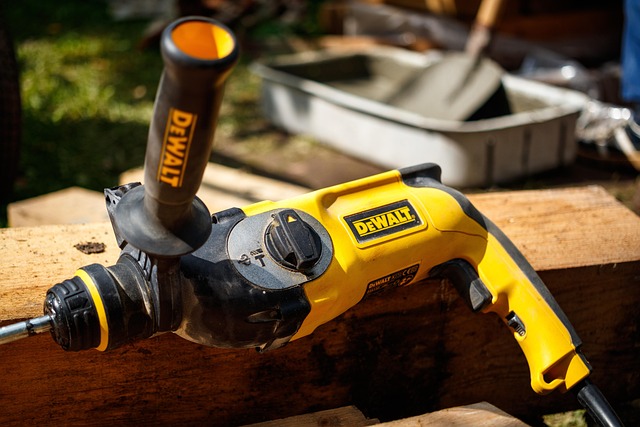
A hammer drill (often called a percussion drill) looks like a standard drill but has a selectable “hammer” mode, usually indicated by a small icon of a hammer on the collar.
How It Works
When you engage the hammer mode, the drill doesn’t just spin the bit. Two ribbed metal discs inside the drill slide against each other, causing the chuck to punch forward and backward rapidly.
- The Physics: Think of it as spinning a chisel while hitting the back of it with a hammer thousands of times per minute (BPM – Blows Per Minute).
- The Result: This pulverizes masonry (brick, concrete, mortar) while the rotation scoops the dust out of the hole.
Key Features
- The Chuck: It uses a 3-jaw adjustable chuck (usually keyless) that opens and closes to accept round or hex-shank drill bits.
- Versatility: Most hammer drills have 3 settings: Drill (spin only), Drive (clutch engaged for screws), and Hammer (spin + punch).
- The Feel: It is heavy, loud, and requires two hands for stability when drilling masonry.
When to Use It
- Drilling into brick, cinder block, or concrete.
- Drilling large holes in wood (using the standard drill setting).
- Mixing paint or mortar (due to high sustained speed).
Pro Warning: Never use the “Hammer” mode on wood or metal. The punching action will split the wood and skitter off the metal, ruining your work surface.
Tool 2: The Impact Driver (The Torque Monster)
The impact driver is shorter, stubbier, and deceptively loud. It does not have a slip clutch (the ring with numbers on a regular drill). It is built for one thing: raw power.
How It Works
An impact driver uses a mechanism consisting of a heavy anvil and a spring. When the resistance on the screw gets tough (like when a long screw is halfway into a deck joist), the spring compresses and the anvil strikes the output shaft rotationally.
- The Physics: Imagine trying to loosen a stuck bolt with a wrench, and you hit the handle of the wrench with a hammer to jar it loose. The impact driver does this roughly 50 times a second.
- The Result: Massive torque (turning power) with zero kickback to your wrist.
Key Features
- The Chuck: It uses a 1/4-inch hex collet. You cannot use smooth round drill bits; you must use bits with a hexagonal shank.
- No Clutch: You cannot dial down the power easily (unless it has electronic speed settings). It is full power or nothing.
- The Feel: Compact and fits in tight spaces. It is incredibly loud—hearing protection is mandatory.
When to Use It
- Driving 3-inch deck screws.
- Driving lag bolts.
- Removing rusted or stuck nuts.
- Self-tapping screws into metal.
Head-to-Head Comparison
Here is how they stack up in real-world scenarios.
| Feature | Hammer Drill | Impact Driver |
| Primary Job | Drilling Holes | Driving Screws |
| Bit Holder | 3-Jaw Chuck (Adjustable) | 1/4″ Hex Quick-Connect |
| Concrete/Brick | Excellent | Poor (Not recommended) |
| Wood Screws | Good (but can twist your wrist) | Superior (Fast & Easy) |
| Precision | High | Low (Can over-drive screws) |
| Noise Level | Loud | Very Loud (High pitch) |
Real-World Scenarios: Which Do You Grab?
Scenario A: Building a Wooden Deck
You are framing with pressure-treated lumber and laying down deck boards.
- The Choice: Impact Driver.Why? You will be driving hundreds of long screws. A hammer drill would strip the screw heads (cam-out) and twist your wrist every time a screw hits a knot. An impact driver will sink those screws effortlessly.
Scenario B: Installing Shelves on a Brick Wall
You need to put plastic anchors into a masonry wall.
- The Choice: Hammer Drill.Why? You need to bore a clean hole into the brick. An impact driver cannot drill efficiently into masonry; it will just overheat the bit.
Scenario C: Assembling IKEA Furniture
You are putting together a particleboard cabinet.
- The Choice: Standard Drill (or Hammer Drill in “Drill” mode) set to low torque.
- CRITICAL WARNING: Do not use an Impact Driver for flat-pack furniture. It has no clutch. You will drive the screw right through the cheap particleboard and ruin the piece instantly.
The “Combo” Solution
If you are a homeowner looking to buy your first serious tool, you might be asking: “Do I really need to buy two tools?”
The honest answer is: Ideally, yes.
Manufacturers know this, which is why they sell “Combo Kits” containing both a drill and a driver for a discounted price. This is usually the best value for money.
However, if you can only buy one, here is the decision matrix:
- Buy the Hammer Drill IF: You live in a house with brick/concrete walls, or you do more renovation/repair work (drilling holes) than construction. It is the “Jack of all trades.” It can drill holes and drive screws (albeit slower than an impact driver).
- Buy the Impact Driver IF: You already have a basic drill, or if 90% of your work involves wood construction (building boxes, decks, fences).
Safety & User Safety
A note on safety and responsible tool usage. These tools are powerful.
- Hearing Protection: Impact drivers can exceed 100 decibels. Prolonged use without ear protection can cause permanent hearing damage.
- Eye Protection: Hammer drilling generates flying concrete dust and chips. Always wear ANSI-rated safety glasses.
- Battery Safety: Lithium-ion batteries are fantastic, but never store them in extreme heat or use them if the casing is cracked.
Final Verdict
The debate between Hammer Drill vs. Impact Driver isn’t really a competition; it’s a partnership.
- The Hammer Drill clears the path (makes the hole).
- The Impact Driver finishes the job (secures the fastener).
If you are serious about DIY, you will eventually own both. But if you are starting today, look at your walls. If they are concrete, get the hammer drill first. If they are drywall and wood, the impact driver will change your life.
Did this comparison help you decide which yellow or red box to grab? If you are curious about which drill bits you need for specific materials, let me know and I can guide you through the maze of cobalt, titanium, and masonry bits.
Want to relax while doing housework? Try this app on the Apple App Store. It’s free!
https://apps.apple.com/us/app/sonidos-relajantes-para-dormir/id6756495755